


Here’s a scene you’ve probably witnessed. Maybe you’ve been part of it.
Someone on the team — an engineer, a designer, maybe a PM — builds a demo. It’s impressive. It works. It solves a problem that customers have been complaining about, or it does something that wasn’t possible a year ago. They show it to the team. The team gets excited. They show it to leadership. Leadership gets excited. And then, if you’re lucky, someone says, “Let’s get this in front of a few design partners.” More often, leadership says, “Let’s ship this: Let’s invest in it. Let’s build it out. Let’s market it.” A roadmap materializes. Resources get allocated. The machine starts moving.
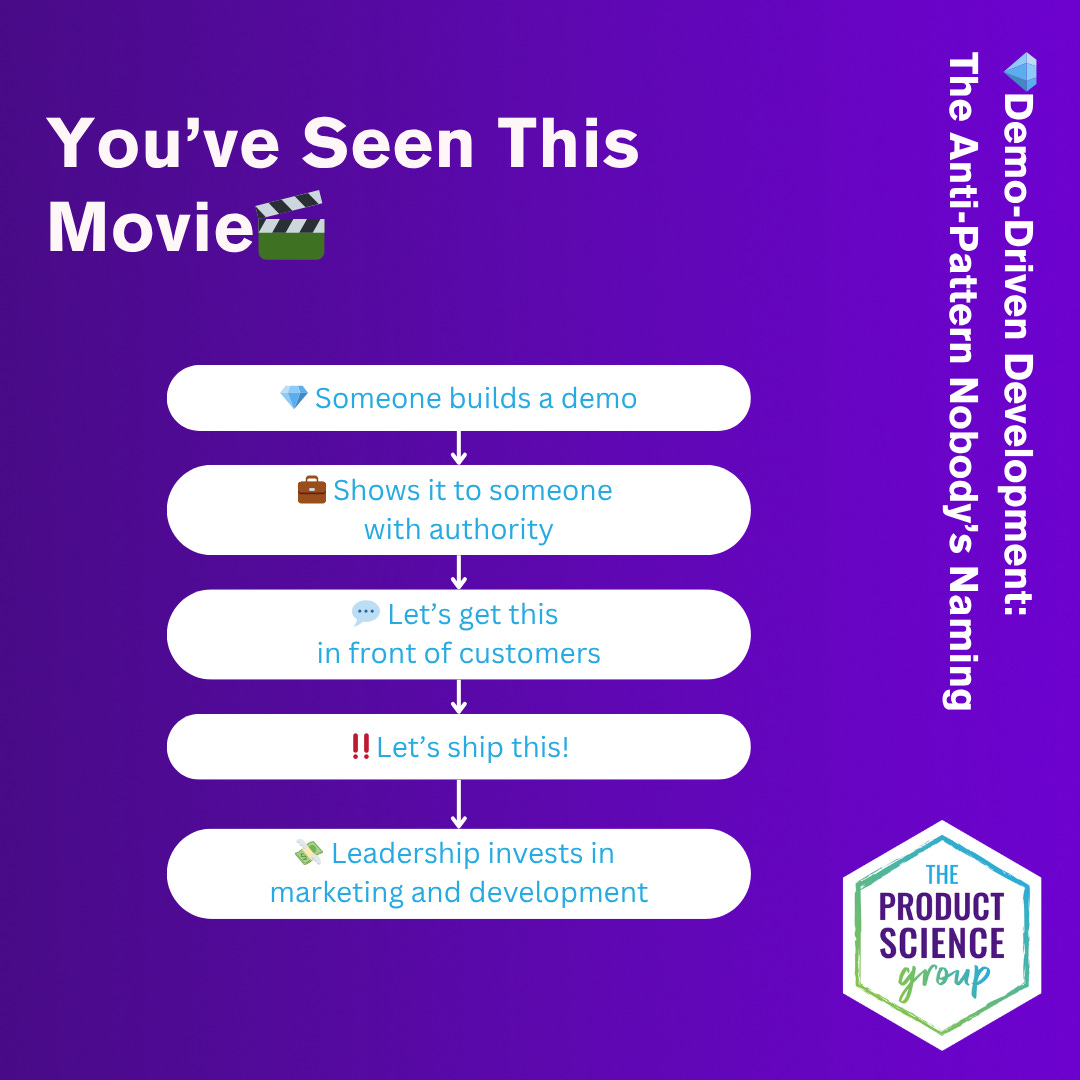
And at no point in this sequence do the decision-makers step back and ask: Is this the most valuable problem we could be solving right now? For this company? For this product portfolio? Is this the right solution — or just the first one someone built?
I call this demo-driven development. And it’s been around for as long as I’ve been in product — nearly two decades.
Two Flavors, Same Root Cause
The pattern shows up in two ways.
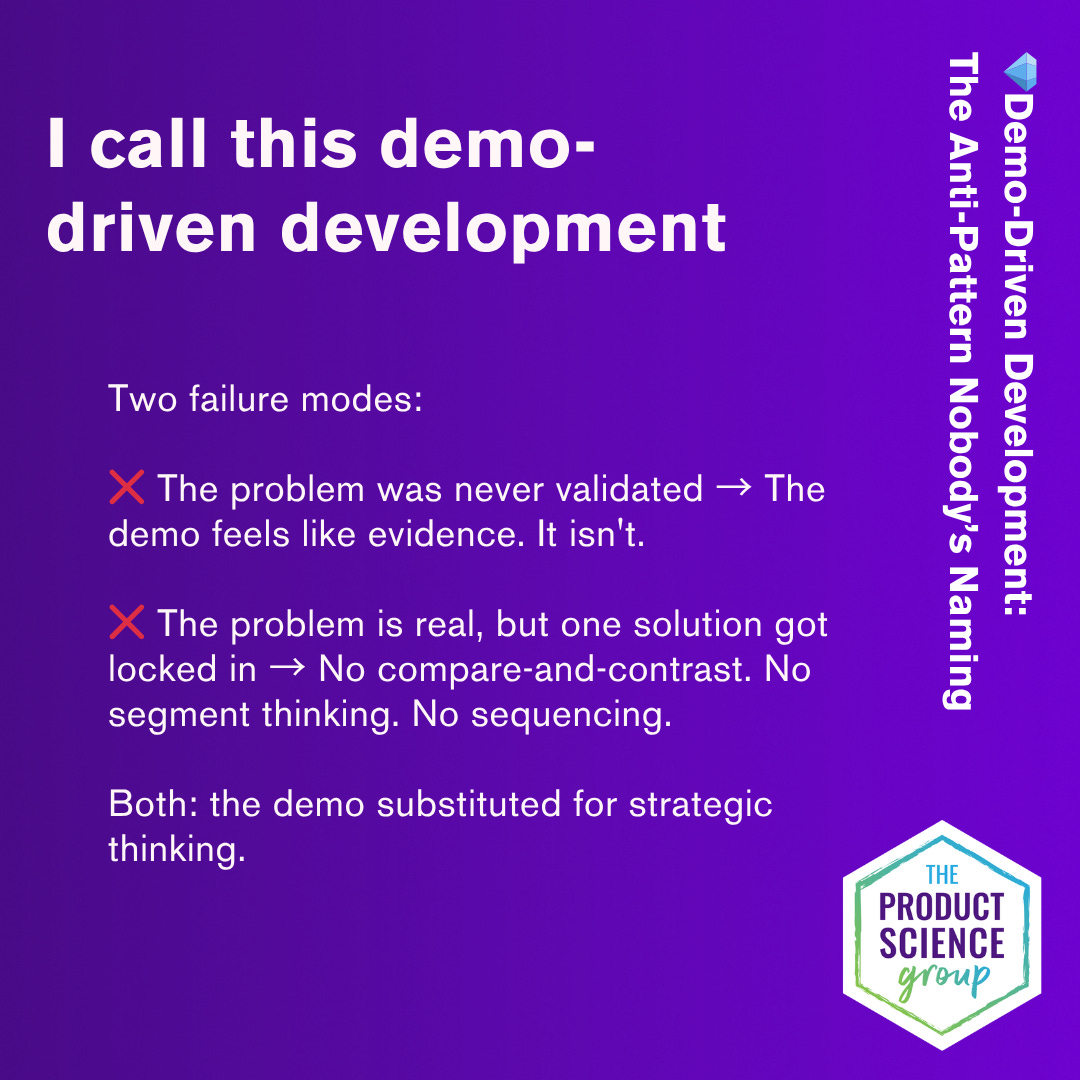
In the first, the team hasn’t validated the problem at all. A customer complained, or a new technology made something cool possible, and the team jumped straight to building. The demo feels like evidence that they’re on the right track. It isn’t. It’s an assumption wrapped in working code.
In the second, the team has identified a real problem — but they’ve locked onto one solution without doing the compare-and-contrast work. They’re not asking whether this is the best possible solution, or which customers it serves and which it doesn’t. They’re not thinking about which market segments to address first or why. They go straight to finding a couple of design partners who’ll confirm the thing they built is useful.
And of course those partners will say it’s useful. If you find someone with a problem and hand them a working solution, they’ll say thank you. That doesn’t mean it was the best thing to build. It doesn’t mean it’s the best use of the company’s resources. And even if building is super cheap now, the time and attention of your customers is not. Their eyeballs and their minutes are a precious resource. We still need to think deeply and strategically about which ideas we put in front of them, when, and which conversations we have with them.
Both flavors share the same root cause: the demo substituted for strategic thinking. In one case, it replaced problem discovery. In the other, it replaced the diverge phase of solution discovery.
This Isn’t New. But AI Made It Worse.
Demo-driven development predates AI. It predates agile. It’s what happens whenever a team confuses having a working prototype with having a strategy.
But I’m naming it now because AI has made it dramatically more dangerous.
When it took months to build a prototype, the friction of building created a natural check. You had time to think, to question, to pressure-test assumptions before the thing existed. That friction is gone. AI can help a team go from idea to working demo in hours, sometimes minutes. The prototype is more polished, more convincing, and more emotionally compelling than anything we could build before. And every stakeholder in the room is going to look at it and think: why wouldn’t we ship this?
Here’s why: because a demo is not a strategy. A prototype that works is not evidence that you’ve found the highest-impact use of your team’s time. And the ability to build fast makes the cost of building the wrong thing higher, not lower — because you’ll build more wrong things, faster, and every one of them will consume resources, create expectations, and generate switching costs when you finally realize you need to change direction.
The Misconception Underneath
There’s a deeper issue here that I see in teams at every level of maturity: the belief that product discovery means putting something in front of a customer and getting feedback.
That’s part of discovery. It’s not all of discovery. And it’s not the part that prevents demo-driven development.
The part that prevents it is the strategic work that happens before you build anything — identifying who you’re building for, what pain you’re solving, what outcome you’re driving, and in what order. Figuring out what your evidence actually says about where the highest-value opportunity lives. Making tradeoffs explicit instead of letting the most exciting demo win by default.
Most teams skip that work. Not because they’re lazy or incompetent. Because nobody taught them that it’s a separate step — and because the demo is right there, working, waiting to be shipped.
If This Sounds Familiar
I’m not offering a solution in this post. That’s deliberate. The solution is an entire methodology — one I’ve spent nearly two decades developing, teaching, and refining. I’m writing a book about it right now, The Product Science Principles, and demo-driven development is where Chapter 2 begins.
But naming the problem is the first step. So the next time you’re in a room where everyone is excited about a demo and nobody is asking whether it’s the right thing to build — you’ll have a word for what’s happening.
And maybe that word will be enough to slow things down just long enough for the right questions to get asked.
I’m looking for beta readers for the book — people who’ll read early chapters and share their honest, in-the-moment reactions as they go. If that sounds interesting, reply and I’ll send you what I’ve got.
And whether or not you want to read early drafts, I’d love to hear from you: are you seeing demo-driven development in your organization? What does it look like? Hit reply and tell me — it’ll make the book better.